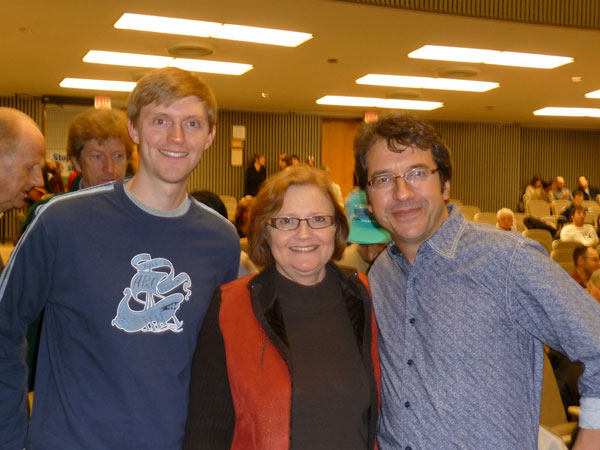
George and me

By Chris Tindal, November 30, 2009 5:49 pm
Chris and Mardi Tindal with George Monbiot in Toronto. To the left of the frame, John Ralston Saul and R.H. Thompson may have gotten a bit shoved out of the way.

Chris Tindal and Mardi Tindal with George Monbiot in Toronto. To the left of the frame, John Ralston Saul and R.H. Thompson may have gotten a bit shoved out of the way.

I went to hear George Monbiot speak on Saturday in Toronto, and was excited to see that he was there in person. Monbiot is one of the best (and best-known) climate change journalists in the world. A few years ago he swore off flying because of its impact on our planet, and since then has made most of his appearances via video conference. He is physically in Canada this week, however, because our “government’s behaviour in the (UN climate) talks is so destructive and the development of the oil sands is so damaging to global efforts to prevent climate breakdown” that he felt compelled to pay us a visit.

Monbiot’s message for us is blunt. He emphasizes that he really likes the Canadians he’s met and that he finds us to be very sensible, but that “the distance between ordinary Canadians and those who define your reputation on an international stage is an enormous gulf.” Our government’s actions are causing so much “shock and revulsion” internationally that “Stephen Harper and Jim Prentice threaten to do as much damage to your international standing as George W. Bush and Dick Cheney did to that of the United States.”

His concern is both regarding our behaviour at UN climate talks and our increasing production of dirty oil. The “oil curse” is not only bad for our ecology, he says, but our democracy. International examples show that dependence on oil “brutalizes a nation…it creates a political class that owes its existence to a primitive and destructive industry.” The process has already started, Monbiot says. “No one can quite believe that this prosperous country is treating its aboriginal peoples like Nigeria treats the Ogoni of the Niger Delta.”

Read his plea to Canadians in today’s Globe and Mail: Please, Canada, clean up your act

ps. I will add that all of this has a flip side. If we do clean up our act and provide leadership, we can, as Stephen Lewis says, quickly restore our reputation on the international stage while simultaneously strengthening our domestic economy by becoming more efficient and competitive. That’s our choice: lead of follow, help or hurt, become renowned or repudiated.
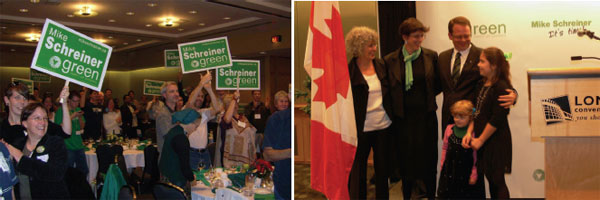
A new era for the Green Party of Ontario

By Chris Tindal, November 27, 2009 2:50 pm

Saturday night at the Green Party of Ontario's leadership convention

I was asked to write a summary of the provincial Greens’ recent meeting in London, Ontario for the party’s monthly newsletter (PDF). Here it is.

I think that our new leader Mike Schreiner said it best when describing the outcome of the Green Party of Ontario’s recent leadership conference and policy convention. “There’s a sense of a new beginning, and a new era in the party.” The momentum and energy coming out of our weekend in London was that of a party that has embraced a common vision and is hopeful and upbeat about the future.

Green members from across the province met in London, Ontario from October 13th to 15th. While there were policy workshops and debates, most of the buzz was centered around celebrating outgoing leader Frank de Jong for his amazing 16-years of service, welcoming and affirming incoming leader Mike Schreiner and listening to and learning from great speakers from within and without the party.

For me, three themes emerged: that we must be the party of hope and principled solutions, that we already have more influence and impact than we know, and that in order to reach new levels of success we’re going to have to get to work.

To a certain extent, those three themes were encapsulated by three presentations. The first, by Schreiner. “Don’t appeal to fear when dealing with climate change,” he said during a town hall meeting on the Saturday, “even though fear is justified.” Instead, he said, focus on all of the great opportunities that will come out of transitioning our economy, for example.

The second, by Markham City Councillor Erin Shapero, a non-partisan, who told us in an inspiring speech that “[Greens] have shone light that has shined brighter and reached further than you may realize. Thanks to your leadership things are trickling down and happening [in governments] in ways that you maybe haven’t imagined,” before predicting that there will be Green MPPs at Queen’s Park after the next election in 2011.

The third, by Robert Routledge, a Green party member and former Barack Obama field organizer, who shared campaigning insights for an hour to a captivated audience on Sunday morning. “The other parties are better at this (campaigning) than we are,” he said, “but we can choose to out-work them. What we’re trying to do is really really hard. It’s a grind. So we can take pride in grinding it out against the other parties.”

In other words: stay positive, recognize the amazing things we’ve already done, and get to work on the incredible task ahead.

Of course, no summary can do the whole weekend justice, particularly this short one. We also heard greetings from the European Greens, communications and messaging ideas from broadcaster Ralph Benmergui, a “roast” of Frank de Jong by his partner Kelley Aitken, a rousing acceptance speech from Mike Schreiner, and more. To read even more about this weekend (including highlights from some of the speeches I mentioned), check out these blog posts:

Convention opens with tributes to Frank de Jong

Yohan Hamels brings greetings from European Greens

Mike Schreiner inspires members, sets out vision

Shapero: Greens are needed now more than ever

Greens learn “lessons of an Obama field organizer”

Acceptance Speech from Mike Schreiner

Moderator Mardi Tindal speaks at climate change rally

By Chris Tindal, November 20, 2009 3:30 pm

The 40th Moderator of the United Church of Canada Mardi Tindal (yes, my mom) addresses the 350.org climate change rally at Queen’s Park in Toronto on October 24, 2009. I shot this on a $200 Flip video camera and edited it using iMovie, so go easy on my videography skills.

An off-the-cuff open letter to Charlie Angus

By Chris Tindal, November 18, 2009 3:28 pm

Dear Charlie,

Jane Taber reports over on globeandmail.com that you want MPs like yourself to be banned from Twitter “to save politicians from looking like idiots.”

“Here’s a better idea,” wrote Jeff Jedras. “Stop being idiots.”

We could probably just leave it there, Charlie, but I want this point to be very clear. Our MPs are letting us down disastrously. There are many good individuals who sit in the House of Commons and you may well be one of them, but as a group you are delivering concentrated packages of FAIL on a daily basis. Our MPs do act childish, they do play games, and they have created a complete vacuum of leadership at a time when we need it the most. The solution is not to hide that disgrace, the solution is to change it.

I’m surprised that anyone who believes in transparent and accountable democracy could conclude that a tool that  “exposes” a problem with how Parliament (doesn’t) work should be removed from the equation. On the contrary, anything that exposes the pathetic sideshow that is the current Parliament should be amplified in the hopes that it will snap us out of our collective slumber and elect a group of people who will actually work together for the good of the country.

And Charlie, those of us who follow the tweets of public figures? We’re not “imaginary friends,” as you called us. We’re people, voters, citizens. Don’t call us names.

As for your claim that banning Twitter would somehow force MPs to treat each other like humans because they wouldn’t have their noses in their mobile devices all the time, I’ll grant you that sounds like good meeting etiquette. But when I read that you’re someone who “freely admits that he couldn’t do his job without his BlackBerry – he uses it at committee to check facts with his staff and to Google other points of discussion,” it seems like you’re specifically targeting tools that allow politicians to communicate with the public while giving a pass to other equally anti-social BlackBerry habits.

There, rant over. Let’s get back to work. It’s getting hot in here.

Best,

Chris

Greens learn “lessons of an Obama field organizer”

By Chris Tindal, November 16, 2009 12:32 pm

Crossposted from my blog on gpo.ca, because it’s that damned important.

Robert Routledge / Submitted photo

Robert Routledge / Submitted photo

Robert Routledge ran his “lessons of an Obama field organizer” convention workshop in the same way that Obama campaign meetings themselves were run. “All Obama meetings start with music,” he explained, usually Waiting on the world to change by John Mayer.

From “music” the meeting then moves to “stories.” Routledge told his story of how he became a staff organizer on the campaign that changed America. It began in Milwaukee where Routledge performed the simple act of getting a computer printer to work. He then quickly discovered that on the Obama campaign, “if you were competent at anything you were promoted quickly.” It wasn’t long before a serendipitous series of events placed Routledge on the Milwaukee evening television news as a campaign spokesperson, doing his best to “stay on message” based on what he’d learned about Obama by watching CNN. Ultimately he would end up establishing the campaign office in Pittsburgh and traveling around the country from state to state as a “fixer.”

After the meeting organizer has told their story, they invite everyone in attendance to turn to someone they don’t know very well and ask them “what is your story and why are you here?” It’s a powerful question that in just one or two minutes can reveal common ground or unearth a diversity of motivations and backgrounds.

Stories are important, Routledge explained, because the Obama campaign was about Obama’s story. “We were trained in excruciating detail how to tell Barack’s story,” he said, focusing on his Harvard education and background as a community organizer from the south side of Chicago. (That discipline was effective all the way to here in London. When the room was asked, those were the first two things that people recalled about Obama’s background.) Internally, the stories of the staff and volunteers of the Obama campaign connected them to each other and built community. Externally, Obama’s story allowed the campaign to connect with people on a human level.

“What this campaign does”

Once everyone has had 60 seconds to tell their story and there’s a good vibe in the room, Routledge drops the hard truth on his group of new volunteers. “Ok,” he says, “what this campaign does is we knock on doors and make phone calls. That’s it.”

Thus he established a main theme of his message for the Green party. The organizers who were successful, he said, are the ones who could keep it simple and focused on the things that actually matter and win votes. Other organizers who got distracted by side projects and activities that weren’t a good use of time were not successful and were not given further responsibility.

That meant making phone calls non-stop from around 9 a.m. to 5 p.m., then knocking on doors until it got dark, then continuing to make phone calls until 9 p.m. “If you got tired of calls, you knocked on doors. When your feet got sore, you made calls.” Each primary campaign started by making “persuasion calls” focused on convincing people to vote for Obama during early days when they needed to increase their voter base, then moved to making shorter “ID calls” in the later stage of the campaign when they were confident they had enough people persuaded and it was now just a matter of making sure they voted.

Each evening organizers would jump onto regional conference calls where they reported numbers: how many calls did your campaign make that day, how many doors did you knock on, how many voters were IDed, how many volunteers were recruited? In other words, are you doing your job? The goal was for each organizer’s office to make 1000 phone calls and knock on 250 doors per day, and Routledge said he had to “get creative” to become the only organizer to achieve that goal.

“Doing things upsets people.”

Another key lesson for Routledge is that “doing things upsets people.”

“If you’re going to be confident in what you want to do, and [Green Leader] Mike [Schreiner] and [President] Bill [Hewitt] and [Executive Director] Becky [Smit] set the direction and we start moving that way, people are going to be mad at you. They already are. And that’s OK.” An example from Routledge’s experience is that his campaign team placed no value on lawn signs, deciding to almost never give them out. “People were furious,” he said, but it allowed them to focus on other activities (you guessed it: making calls and knocking on doors) that they believed would yield greater results.

In answer to the question of how you deal with people who don’t buy in to your campaign strategy, Routledge takes a tough love approach. “People who don’t buy in to what you’re doing are going to do you more harm than good. Say goodbye to them. Don’t spend a lot of time trying to fix someone because time is valuable.” He emphasized that that doesn’t mean you don’t train volunteers and make an effort to ensure they feel comfortable, but that there’s sometimes a point where it’s better to part ways if things aren’t working out.

“The grind,” and engaging voters

For Routledge, the exciting opportunity for the Green Party of Ontario is the prospect that we can work harder than the other parties. “The other parties are better at this than we are, but we can choose to out-work them. What we’re trying to do is really really hard. It’s a grind. So we can take pride in grinding it out against the other parties.”

Just as successful organizers are able to keep things simple, Routledge had a straight-forward response to the common question about how to connect with young people. “Physically go to where they are and talk to them. This isn’t fancy.”

He also said that the under-30 crowd is a “generation of big ideas.” Tools like Facebook, Twitter, mybarackobama.com, YouTube, were great, “but they were just tools. The campaign was actually about the message. It was a language of big ideas and hope, and that’s how you connect with the under-30 crowd.” Web 2.0 tools are a way for people to connect, he said, not a reason for people to connect.

Stay on message and get emotional

“Greens like being right,” Routledge observed, “and we get frustrated when our views aren’t shared, so we want to educate people, ‘this is important and we’re right’. But as Ralph Benmergui said yesterday, politics is emotional. If we’re not connecting with people on an emotion level, inspiring people to believe that we can do better, [then we're not succeeding]. That’s not just important for Mike and Elizabeth, that’s important for you at the door.”

Routledge shared that on the Obama campaign if anyone went off message (including if someone spoke to the media and gave a perfect message but were not authorized to have done so) they were immediately fired.

Damage control: “The world ended”

“Don’t panic. But actually, panic! Panic like your hair is on fire!” In other words, it’s important to stay calm, while also taking swift action to manage a bad situation. Things will get very bad, Routledge said. “When Reverend Wright happened and a few days later Obama made his comments about people who cling to guns and religion, the world ended.” How you then choose to deal with a bad situation is important. You have to quickly realize that “we can’t unsay what’s been said or undo what’s been done,” then start managing what happened.

Make friends

In the period of time when you’re not actively campaigning, the best thing you can do is make friends, Routledge said. Then when a campaign does come around you can use those relationships. “Don’t make it about the party or the ideas, make it about emotions and relationships.”

We can also do things with our supporters after the campaign, he said, pointing to a grassroots initiative in the U.S. made up largely of identified Obama supporters that’s now working behind the scenes to win the health care debate. “Our supporters list is a powerful, powerful thing to have.”

Routledge concluded by asking some provocative questions about where the Green party should go from here. “Do we want to make this about being right? About winning? About building community? Who are we?” For him, it comes down to choice. We get to choose what we want to do in 2011. We get to choose whether or not to work harder than the other parties, whether or not we make thousands of phone calls and knock on thousands of doors. It’s up to us, and it’s that simple.

Panorama Theme by Themocracy